
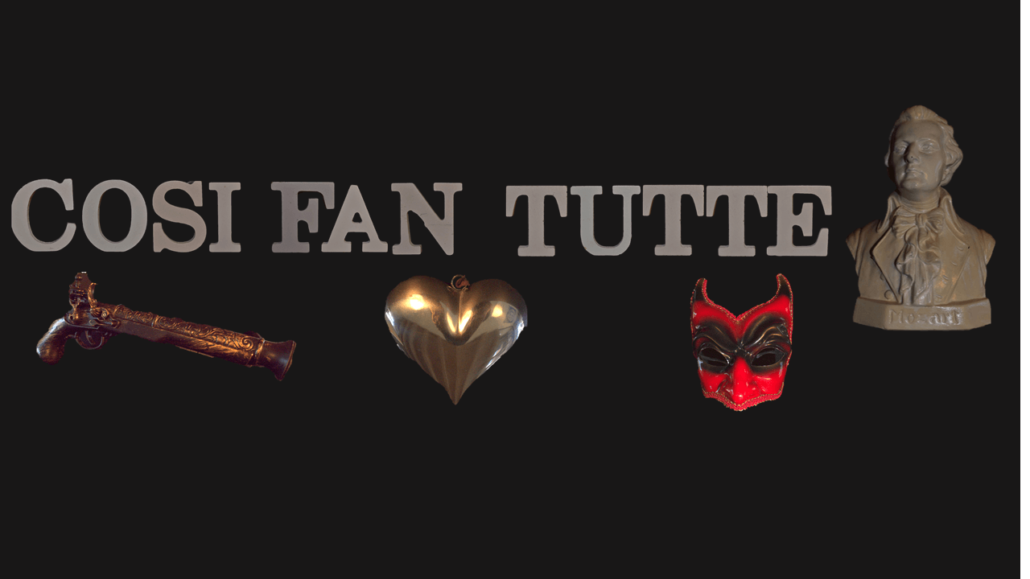
The online opera guide to COSI FAN TUTTE
When Mozart wrote “Cosi fan tutte” in 1790, he was economically devastated. He wrote this opera in an incredible 2 months in his year of death. Mozart again offers us an abundance of melodies. Especially the ensemble scenes like the love duets “soave sia il vento” or “il mio cor vi dono” remain immortal.
OVERVIEW & QUICK ACCESS
Content
♪ Synopsis
♪ Act I (The bet- scene, The farewell-scene)
♪ Act II (The masquerade-Scene/ Marriage-scene)
Highlights
ROLES & SYNOPSIS OF COSI FAN TUTTE IN 4 MINUTES
COSI FAN TUTTE ACT I
The composition history of Cosi fan tutte
When Mozart wrote «Cosi fan tutte» in 1790, he was economically devastated. His finances had been in a bad state for almost 4 years without him restricting his lifestyle for a long time. The desperate travels to Frankfurt in 1789 and 1790 did not help, so that he wanted to write the opera Cosi in shortest time to get money quickly into his empty cash box. He began working on the score in November 1789 and on New Year’s Eve he showed excerpts from the opera to various friends (including Joseph Haydn, whose opinion Mozart held in high esteem). On 26 January, after only 2 months, the premiere took place. The reception of the Viennese audience was friendly but nevertheless lukewarm. Mozart remained unlucky, because shortly afterwards his patron Emperor Joseph II died and after the 5th performance the performances were stopped due to the ordered state mourning.
Cosi fan tutte’s great overture
Shortly before starting work on Cosi fan tutte, Mozart had composed his last three grandiose symphonies. Mozart was at the height of his symphonic career. So it comes as no surprise that the overture to Cosi is one of the absolute highlights of this opera. The orchestra sparkles in all colours. The brass groups in particular are upgraded like never before in an opera, listen for example to the serenade scene. A respected musicologist regarded Cosi fan tutte as «the most beautiful orchestral work of the entire 18th century».
The terzetti of Guglielmo, Ferrando and Don Alfonso
Synopsis: Guglielmo and Ferrando, two officers of the Neapolitan Army, are in the coffee house. The old philosopher Don Alfonso sits at their table. The two young men rave about their fiancées and sing about their virtues and loyalty to them.
Listen to this trio from the great recording by Karl Böhm from 1964, which we will meet several more times. The singers are Alfredo Kraus, Giuseppe Taddei and Walter Berry.
La mia Dorabella capace non è - Kraus / Taddei / Berry
Synopsis: Don Alfonso, made cynical by life, claims that no girl is ever faithful. The two young men are indignant and demand a duel. Alfonso offers them a bet, they only have to grant him one day. Guglielmo and Ferrando join in. The three of them have set a bet amount of 300 Guilders. The two men are already imagining what they will do with the money they have won.
Una bella serenata - Araiza / van Dam / Allen
Mozart‘s great ensembles
Synopsis: The two sisters Dorabella and Fiordiligi are in the garden. They rave about their fiancée and already imagine the wedding.
Listen to the duo of the two Yankee Divas (the term stems from Di Donato) Renee Fleming and Joyce di Donato in a wonderful concert excerpt.
Ah guarda sorella - Fleming / di Donato
Synopsis: Don Alfonso joins the ladies and, still in shock, tells them the terrible news that their fiancées have to go to war.
No other opera by Mozart offers as many ensemble pieces as Cosi. There are 13 pieces in total. There are as many as in the other two Mozart / Da Ponte operas (Le nozze and Don Giovanni) together. The plot of this opera almost screams for duets, trios, etc. Mozart was able to draw from the full source of inspiration, because his mastery of chamber music forms such as string quartets with their polyphonic forms was the ideal basis.
In the following recording we hear many protagonists of the famous «Viennese ensemble» from the fifties. What is the philosophy behind this ? «The conductor Josef Krips brought it to the accepted formula that only an instrumentally guided voice is a Mozart voice. That accuracy and flexibility, elegance and noblesse are the foundations of Mozart singing» (Kesting). Listen to some of the protagonists of this permanent ensemble of the Vienna State Opera. You hear the singer Christa Ludwig, Lisa della Casa, Anton Dermota, Erich Kunz and Paul Schöffler.
Sento o Dio - Ludwig / della Casa / Dermota / Kunz / Schöffler
The great farewell Scene – Mozart’s great soave sia il vento
Synopsis: Guglielmo and Ferrando join them. The two women are heartbroken and want to die. Triumphantly, the two men make Don Alfonso signs. Don Alfonso amuses himself deliciously. Don Alfonso has disguised villagers as soldiers who accompany them to their ship.
Bella vita militar
Synopsis: The two officers say goodbye to their fiancé. Wistfully, Alfonso and the two women look after the ship, which is slowly moving away from them.
This trio is one of Mozart’s absolutely greatest vocal pieces, he takes us into a supernatural world. Mozart accompanies the three voices with muted strings that imitate gentle waves. You will hear this trio in an interpretation by Christa Ludwig and Elisabeth Schwarzkopf and Walter Berry. This recording is taken from the legendary Cosi fan tutte recording produced by Walter Legge.
Soave sia il vento (1) - Schwarzkopf / Ludwig / Berry
You hear a second version in the Solti recording with von Otter, Fleming and Perrusi.
Soave sia il vento (2) - Solti / Fleming / von Otter
Dorabella‘s and Despina‘s arias
Synopsis: Dorabella’s agitated. In her heart, relentless storms rage.
In her aria «Smanie implacabile», the romantic Dorabella expresses her soul’s anguish and pain that will lead her to death. Mozart dramatically set this lamento to music, Dorabella repeats the conclusion «col suono orribile die miei sospir» (the terrible sound of my sighs) several times until she exhausted sinks down.
Listen to Elina Garanca in this aria of Dorabella.
Ah scostati…smanie implacabile - Garanca
In uomini In soldati – Cecilia Bartoli’s great performance as Despina
Synopsis: The housekeeper Despina joins them. She cannot understand the grief of the two. Should their fiancée fall in the war, they could quickly find a replacement. And, of course, one should not expect loyalty from men in general and from soldiers in particular.
Mozart offers us a wonderful portrait of Despina. She has learned in life that one cannot expect fidelity in love. So in her aria she plays with the word «fedeltà», repeating it three times with more and more coloratura, so that everyone who believes in it must appear as a naive person. In the second part, she laments with indignation that the men want to take the women for their pleasures with hypocritical tenderness, and finally she asks the women to pay the men back in the same coin.
This piece gives a Despina, at the height of her task, the opportunity to show in a short time the many comedic and vocal aspects of this short aria. Cecilia Bartoli solves this task with a wonderful mixture of charm, elegance and cunning. Pay attention to her played indignation in «non vi fate sentir per carità» or her mischievous facial play in «chieder pietà».
In uomini in soldati - Bartoli
The sextett alla bella Despinetta
Synopsis: Don Alfonso bribes the housekeeper Despina to take part in the game. Ferrando and Guglielmo enter dressed as Albanians and rave about the two beautiful ladies. Fiordiligi and Dorabella are indignant and want to throw the two strangers out of the house.
Listen to another great ensemble piece from the 1955 Karajan recording.
Alla bella despinetta - Schwarzkopf et al.
Come scoglio – a great aria of Schwarzkopf’s Fiordiligi
Synopsis: Then Alfonso has the idea to welcome them as old acquaintances. But Fiordiligi explains her heart is as firm as a rock.
This piece by Fiordiligi is one of Mozart’s most difficult arias ever. The tonal range of the aria is large and the jumps from high to low nots usually fall into the same phrase. For example, right at the beginning of the second line in «contro venti e tempesta» to underline the drama of Fiordiligi’s statement «like a rock unshakeable» (Come scoglio). In the second part (Cosi ognor) we hear the romantic, rapturous Fiordiligi. In the third part she sings with greater certainty the «come scoglio» passage (only death can change the sensation). The aria ends with a beautiful but demanding passage with many coloraturas, which have to be sung in fast tempo and with much intensity and sometimes in very high register.
The Fiordiligi was one of the five central roles Elisabeth Schwarzkopf played in her life (alongside the Marschallin, Donna Elvira and the two Countesses in Nozze and Capriccio). Her vocal style and her voice were a perfect match for these roles. Perhaps there was no greater Fiordiligi than Elisabeth Schwarzkopf.
Come scoglio (1) - Schwarzkopf
You will hear a second recording from Kiri Te Kanawa. It is more expressive than that of Schwarzkopf, whose interpretation seems to be more inward-looking.
Come scoglio (2) - Te Kanawa
There is a nice anecdote to the aria «Come scoglio». Mozarts is said not to have liked the singer of the first Fiordiligi. Her way of lowering her chin to low tones and throwing her head up on high tones annoyed him, and he is said to have composed the many leaps of the aria to make her look on stage like a cackling chicken gone wild, with a violently shaking head.
The arias of the disguised Albanians - un aura amorosa, another highlight
Synopsis: Guglielmo tries it out with Dorabella but doesn’t succeed with his advances on her. The two men triumph over the steadfastness of their fiancée. Ferrando says that a heart nourished by love does not need any other food and therefore they do not have to fear that their fiancées will become weak.
The opera is based on the diabolical textbook by Lorenzo da Ponte. On the surface it is a comedy about a wicked play. And Mozart poured out his most tender melodies over it.
One of the exclusive highlights of the opera is Ferrando’s aria «un’aura amorosa». Listen to the aria Interpreted by Léopold Simoneau, an excerpt from the Karajan recording. Kesting: «The Karajan recording is one of the great Mozart recordings of the century. It is more than technically perfect, miraculous in its liveliness and subtlety. Simoneau sings his part with indescribable tonal sweetness».
Un aura amorosa (1) - Simoneau
You will hear a second interpretation by Jonas Kaufmann, which was recorded in 1998 at the very beginning of his career. Kaufmann describes in his book «Jonas Kaufmann» (by Thomas Voigt) how this recording came about. He got a call from the great director Giorgio Strehler. A first audition was excellent and the engagement almost a clear thing. But a little later Strehler found Kaufmann to be too old. Kaufmann was only 27! But a few weeks later Strehler approached him again and the cooperation worked out. Kaufmann was highly impressed by the theater genius Strehler, precisely because he did not dictate everything, but encouraged the singers to think along. To his regret Strehler died a few weeks before the first performance of this Milan Cosi fan tutte.
Un aura amorosa (2) - Kaufmann
The beautiful duet with Christa Ludwig and Elisabeth Schwarzkopf
Synopsis: Fiordiligi and Dorabella sit in the garden and sing about their grief.
You hear a wonderful recording of this duo with the dream cast Christa Ludwig and Elisabeth Schwarzkopf with the tender but never sweet accompaniment of Karl Böhm.
Ah, che tutta in un momento - Ludwig / Schwarzkopf
The finale of the first act of Cosi fan tutte
Synopsis: Don Alfonso and Despina don’t give up. The philosopher has an idea: The two Albanians pretend to take poison out of desperation because of the unrequited love. Before the eyes of the women they swallow arsenic. The summoned Despinetta, disguised as a doctor, saves the two. This suicide attempt touches the two women, but they are not (yet) ready to accept the kisses of the rescued men.
The first act ends with a lively sextet with a comedic Despina, who picks up a quack known in Mozart’s time.
We hear the cast from the Karajan recording.
Eccovi il medico - Schwarzkopf / Simoneau / Panerai / Otto / Merriman / Bruscantini
COSI FAN TUTTE ACT II
A libretto without a literary source
Da Ponte wrote this opera without a literary model. An anecdote says that the emperor himself told a story where two men put their fiancées to the test after placing a bet with a third man. There may also have been inspirations in literature, but the libretto must be seen as independent. Throughout history there have been many critics who have considered the libretto too frivolous, including Wagner and Beethoven. The success of the opera was moderate. Cosi fan tutte became basically popular only in the 20th century and is an important part of Mozart’s brightly shining triumvirate of Mozart / Da Ponte operas (with Don Giovanni and Le nozze di Figaro).
In the women’s room
Synopsis: Despina is in the room with the two women and explains to them how to wrap men around their fingers.
See Cecilia Bartoli at the age of 24 years in a television recording from the year 1990.
Una donna da qunidici anni - Bartoli
Synopsis: Dorabella, already fickle, doesn’t see any breach of faith if you just have a good time instead of dying of boredom. It quickly becomes apparent that both already have their favourites.
This piece is a light-footed but demanding duet with many coloraturas, some of which are parallel. Listen to the recording with Elisabeth Schwarzkopf and Nan Merriman from the Karajan recording.
Prendero quel brunettino - Merriman / Schwarzkopf
Mozart’s beautiful, lyrical pieces: The enchanting serenade and the romantic «Il cor vi dono».
Synopsis: In the garden, the two men give a serenade to their beloved.
It is a moment of peace, a brief, enchanted pause, in which lyrical tranquillity reigns, which makes us forget the deceptions and malignancies we have experienced.
Secondate, aurette amiche - Simoneau / Panerai
Synopsis: The couples go for a walk separately. Dorabella is the first to become weak. Guglielmos courting shows effect, and quietly he regrets his friend Ferrando. He even manages to exchange the medallion of Ferrandos, which Dorabella wears around her neck, with his medallion.
This seductive duet was written by Da Ponte with ambiguous verses, but Mozart seems to elude it. He writes another beautiful love duet with the beating hearts.
Listen to a wonderfully languishing, romantic Bryn Terfel in duet with Cecilia Bartoli.
Il cor vi dono - Bartoli / Terfel
Fiordiligi’s struggles
Synopsis: Ferrando also tries his luck. But Fiordiligi remains steadfast.
This aria calls for a vocally agile tenor who masters the coloraturas of this aria and is confident in the high notes. Listen to Francisco Araiza, a proven Mozart tenor.
A lo veggio - Araiza/Marriner
Synopsis: Secretly, Fiordiligi has to admit to herself that her heart beats for the romantic applicant, and she asks her absent fiancee for forgiveness.
Probably Dal Ponte had assigned two arias to each of the sisters, one serious and the other comedic. With Dorabella we can observe it this way. But Fiordiligi’s second aria (after the serious «Come scoglio») remains thoughtful. While Come scoglio was rather dramatic with coloratura, in «per pietà ben mio» the singer must be able to maintain the tension in the long cantilenas over the comparatively long duration of the aria.
«Singing with Soul» was an attribute with which Irmgard Seefried was repeatedly associated. She never spared herself or her voice. Elisabeth Schwarzkopf, who often sang with her, said «with her you can hear how far you can go in expression». Listen to this aria in the interpretation by Irmgard Seefried.
Dorabella’s Aria - She blames the god of love
Synopsis: Guglielmo shows Ferrando the amulet and is pleased about the faithfulness of his Fiordiligi.. Ferrando is devastated. Jealousy and revenge eat him up. Back in the room Despinetta congratulates Dorabella on her catch. Dorabella does not take the blame but elegantly assigns it to Amor, the god of love.
Mozart draws a young, carefree Dorabella in this aria. Listen to the interpretation by Elina Garanca
E amore un ladroncello - Garanca
Mozart’s great love scene of Fiordiligi and Ferrando
Synopsis: Meanwhile, Fiordiligi confesses to Dorabella that she has fallen in love. However, she wants to remain steadfast despite this. She orders Despinetta to get her men’s uniforms. She wants to go with Dorabella to Guglielmo and Ferrando and if necessary die in battle. But at the next rendez-vous she also becomes weak when Ferrando pretends to be on the verge to kill himself with the dagger. She finally surrenders to Ferrando.
This passag has a prominent position in the opera. Mozart and Da Ponte conceived this scene in an unusual way. We first encounter a contemplative Fiordiligi. She is looking forward to seeing her fiancé again soon. Her aria is suddenly interrupted by Ferrando, who takes up her melody and then gives her a slow, romantic declaration of love («Volgi a me»). Accompanied by a romantic oboe Cantilena Fiordiligi’ resistance melts away and the two finish the piece with a wonderful duet.
Listen to Edita Gruberova and Luis Lima in this emotional duet.
Fra gli amplessi – Gruberova / Lima
We rub our eyes in amazement. Wasn’t that a serious love duet? Mozart writes such heavenly music for the «wrong» couples. Do we remember the love duet between Guglielmo and Dorabella with the beating heart («il mio cor vi dono»), wasn’t that also heavenly? Is this the comedy ?
Guglielmo’s frustration
Synopsis: This time it’s up to Guglielmo to get angry with his fiancée.
Listen to Thomas Hampson in Donne mie la fate a tanti.
Donne mie la fate a tanti - Hampson
Cosi fan tutte’s finale
Synopsis: There’s nothing to stop them from getting married. Alfonso arranges a double wedding with Despina disguised as a notary. As soon as the ink under the marriage contract has dried, the surprising arrival of the officers is announced. The two women must now shamefacedly confess everything to them. But the comedy is not yet over. Guglielmo and Ferrando dissolve the masquerade. The women almost lose their minds. Don Alfonso collects the money and reconciles married couples, that have become wiser.
Finale - Gruberova / Ziegler Stratas / Furlanetto / Lima / Montarsolo
Recording recommendation
Warner Classics with Elisabeth Schwarzkopf, Nan Merriman, Lisa Otto, Léopold Simoneau, Ronaldo Panerai and Sesto Bruscantini under the direction of Herbert von Karajan and the Philharmonia Orchestra and Chorus.
or
Warner Classics with Elisabeth Schwarzkopf, Christa Ludwig, Alfredo Kraus, Hann Steffek, Giuseppe Taddei, and Walter Berry under the direction of Karl Böhm and the Philharmonia Orchestra and Chorus.
Peter Lutz, opera inside, the online opera guide to Cosi fan tutte by Wolfgang Amadeus Mozart.
This post is also available in: German



Leave a Reply
Want to join the discussion?Feel free to contribute!